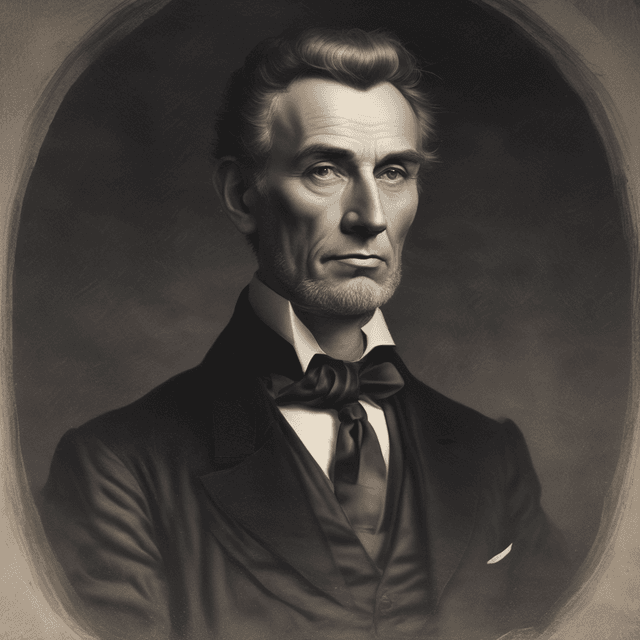
| Name | Lincoln Jesser |
| Role | Politician |
| Term | 1945 - 1953 |
| Title | 34th President of the United States |
| Evaluation | Praised for pragmatic leadership during a turbulent period, but also controversial due to the expansion of executive power and authoritarian tendencies |
| Significance | Played a pivotal role in the aftermath of the Second American Civil War, restructuring the federal government and overseeing major economic reforms and infrastructure projects that modernized the country |
Lincoln Jesser (1882 - 1958) was an American statesman who served as the 34th President of the United States from 1945 to 1953. Jesser is best remembered for his leadership during the turbulent post-war period following the Second American Civil War, as well as his efforts to restructure the federal system and initiate major economic and infrastructure reforms.
Jesser was born in Springfield, Illinois to a family of modest means. He attended Illinois College and Harvard Law School, establishing a legal practice in Chicago before entering politics. Jesser rapidly rose through the ranks of the Republican Party, serving in the Illinois House of Representatives and U.S. House of Representatives in the 1910s and 1920s.
In 1932, Jesser was elected to the U.S. Senate, quickly becoming a leading voice among a new generation of progressive Republicans. He built a reputation as a pragmatic, results-oriented lawmaker focused on economic and social reforms. This helped propel Jesser to the Republican presidential nomination in 1940, though he would ultimately lose the general election.
Jesser's political fortunes changed dramatically with the outbreak of the Second American Civil War in 1941. As the country descended into chaos, Jesser emerged as a voice of authority and unity, casting himself as the only leader capable of restoring order. In the 1944 election, he won a landslide victory over the Democratic incumbent.
Upon taking office in 1945, Jesser immediately set about consolidating federal power to end the conflict. He suspended many civil liberties, authorized the deployment of the military against rebel factions, and empowered the executive branch to take unprecedented control over the economy. While condemned by many as a dictator, Jesser argued these "temporary" measures were necessary to preserve the Union.
Once the civil war was suppressed by 1947, Jesser turned his attention to overhauling the federal government. Drawing on his progressive instincts, he advocated for a restructuring of state-federal relations to prevent future conflicts. This included:
These changes were highly controversial, leading to a protracted battle with Congress. But Jesser ultimately prevailed, using his immense popularity and wartime powers to push through a new constitutional framework that reorganized the United States as a more centralized, unitary state.
With the political system reshaped, Jesser initiated an ambitious program of economic and infrastructure reforms. Key achievements included:
These initiatives were credited with fueling rapid economic growth and technological advancement in the postwar years. However, Jesser's approach was seen as heavy-handed, with the federal government expanding its reach into all aspects of American life.
Lincoln Jesser left an indelible mark on American politics, both positively and negatively. He is remembered as a skilled crisis manager who helped reunite a fractured nation, but also as an authoritarian figure who concentrated power and marginalized democratic checks and balances.
Jesser's supporters view him as a pragmatic visionary who modernized the country and laid the foundations for its 20th century dominance. Critics, however, argue that his actions undermined core civil liberties and transformed the U.S. into an overly centralized, technocratic state.
Nonetheless, Jesser remains a towering, if polarizing, figure in American history. His complex legacy continues to be debated by historians, political scientists, and the general public to this day.
